
OEM/ODM Jewelry Manufacturing for Growing Fashion Brands
A label that moves from single drops to a seasonal calendar runs into the production timetable before it runs into cost. TTT Jewelry publishes 3D CAD at under 48 hours, master sampling at 25–30 days and bulk production at 3–4 weeks, so one full cycle lands at 48–60 days, or roughly 7–9 weeks. That interval, not the unit price, decides how many collections a young brand can support in a year.

Key takeaways
- One development cycle is 48 hours of CAD plus 25–30 days of sampling plus 21–28 days of production.
- Four seasonal drops need overlapping cycles, because a single cycle consumes 7–9 weeks.
- Per-design floors are 50 pieces for 925 sterling silver, 100 for brass and 100+ for stainless steel.
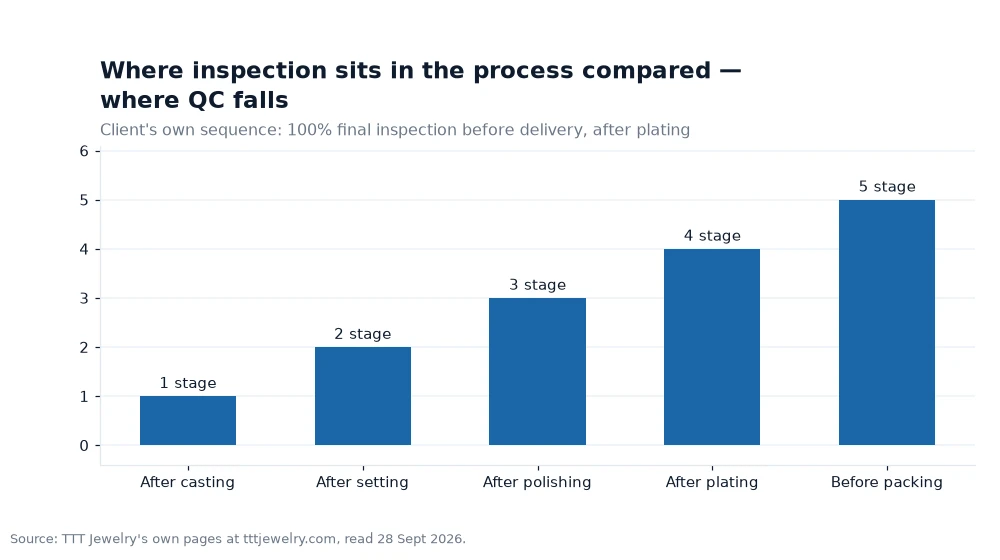
- Five inspection points sit inside the route, and the final check covers 100% of pieces.
The calendar sets the ceiling on a season
The first limit on a growing brand is not factory capacity. It is the length of the loop between a sketch and a shelf-ready piece. Add the published stages: 2 days for CAD, 25–30 days for a master sample, and 21–28 days for bulk. The sum is 48–60 days before packing and freight are counted.
A brand planning four drops a year has about 91 days between them. One unoverlapped cycle eats 48–60 of those days, leaving 31–43 for selling, reordering and shipping. The margin is thin, but it works if nothing slips.
Most young labels meet this problem in their second season, when the first reorder and the next sample request land in the same week. The fix is sequencing rather than speed: approve CAD for the coming drop while the current drop is still in bulk.
Suppliers that run the same six-step path for every client make that sequencing easier, because the handover points are predictable. Full OEM/ODM capability is less about a longer service list than about knowing exactly where a file stops and metal starts.
OEM and ODM answer different growth problems
An OEM order begins with the buyer's own CAD. The factory builds to that file, and the intellectual property stays with the buyer. An ODM order begins earlier, with references, mood boards or one sample, and the factory develops the concept into a producible collection. The published shorthand is "You design, we produce" against "You inspire, we create."
A brand with a settled design language and a trained illustrator usually finds OEM shorter: no concept development, no debate about silhouette. A brand strong on audience and merchandising but thin on technical drawing gets more from ODM, because the shape work happens inside the factory rather than in a freelance studio.
The choice is rarely permanent. A common pattern is an ODM first collection to find shapes that sell, then OEM reorders and line extensions once the brand knows which proportions carry the range.
Either way, ownership terms belong in writing before the first sketch is shared. A brand working with an ODM jewelry manufacturer should confirm that moulds, CAD and the collection itself stay exclusive, because a design that appears in another buyer's line cannot be withdrawn from the market.
Five inspection points, one release decision
Quality is not a single gate at the end. The published route places checks after casting, after stone setting, after polishing, after plating and before packing. Each point catches a different failure, and each is cheaper than the next one down the line.
A casting check finds porosity and short fills while the piece is still raw metal. A setting check confirms that a stone sits level and that the seat holds the girdle. Polishing removes surface scratches and reveals thin sections. Plating inspection looks for coverage on edges and recesses. The pre-pack check is the count, the hallmark and the label.
The quality system behind those gates is certified to ISO 9001:2015, which covers control across production stages rather than one final look. Final QC is published as 100% inspected, meaning every piece passes the last gate instead of a sample from the batch.
| Point | What is checked | Failure it catches |
|---|---|---|
| After casting | Fill, porosity, sprue marks | Weak or incomplete parts |
| After setting | Seat depth, stone level | Loose or tilted stones |
| After polishing | Surface, edges, thin sections | Scratches and worn detail |
| After plating | Coverage, colour match, adhesion | Patchy or peeling finish |
| Before packing | Count, hallmark, label | Wrong item in the carton |
For a small brand the practical value is the paper trail. A check recorded at each point tells the buyer where a fault entered, which is the difference between a rework and a remake.
Minimums that suit a first or second season
The published floors are per design, not per order: 50 pieces in 925 sterling silver, 100 in artisan eco-brass and 100+ in stainless steel. A three-design silver capsule therefore commits 150 pieces, while the same design count in brass commits 300.
That gap shapes the merchandising plan. Silver at 50 lets a label test a shape and a finish with modest stock. Brass at 100 suits a broader range where the lower metal cost supports more colourways, and the custom brass jewelry line is where many labels try texture and tone before moving a proven design into silver. Stainless at 100+ is the durability play, and it is the line where a PVD colour decision adds a chamber run rather than a dye lot.
None of these floors says anything about demand. They say how many designs a budget can carry at once. A brand with 400 pieces to spend can open eight silver designs or four brass ones, and the information from eight shapes is usually worth more than a lower unit cost on four.
Worked example
A label plans a spring drop of three silver designs and two brass designs. At the published floors the order is 3 × 50 + 2 × 100 = 350 pieces. Because final QC inspects 100% of pieces, the last gate checks 350 pieces rather than a sample of 35.
The calendar works out at 48 hours, which is 2 days, plus 25–30 days of sampling plus 21–28 days of production. The fast end is 2 + 25 + 21 = 48 days and the slow end is 2 + 30 + 28 = 60 days. That is 6.9 to 8.6 weeks, conventionally rounded to 7–9.
If the buyer needs a second sampling round, add another 25–30 days. The cycle becomes 73–90 days and no longer fits inside a 91-day seasonal gap.
CAD is only 48/600 = 8% to 48/720 = 6.7% of the sampling window. Cutting the file stage in half saves one day, while a single late comment on a stone seat can add a month.
Frequently asked questions
How many collections can a growing brand launch in a year?
Four is realistic only when cycles overlap. One cycle runs 48–60 days, so four non-overlapping drops would consume 192–240 days of development before freight and reorders are added.
Does a first order have to use the lowest minimum?
The lowest published floor is 50 pieces per design in 925 sterling silver. Brass starts at 100 and stainless steel at 100+, so silver is the usual entry point for a test.
Who owns the design in an OEM order?
The buyer does. In OEM the factory produces to the buyer's CAD and the IP stays with the brand, while ODM collections are co-created and kept exclusive to that brand.
Planning the second season
A second season is mostly a scheduling exercise. Fix the design count, apply the per-design floor, and place the CAD review far enough ahead of the sample request that feedback arrives in one round.
Brands that treat the calendar as a constraint rather than an afterthought tend to find the custom jewelry wholesale route easier to plan, because reorders reuse existing moulds and skip development. That is the point where the 25–30 day sample disappears from the critical path entirely.
The rest is discipline. A drop that ships on time with four designs teaches more than a larger drop that arrives after the season has moved on.
Source note: figures come from the manufacturer's own website (tttjewelry.com), read 28 Sept 2026.[1]